
As the freezing temperatures of winter give way to mild spring days, homeowners often enjoy a brief period of relief from high utility bills. However, this transitional period is exactly when you should prepare your property for the upcoming summer heat waves. Failing to adjust your home operating strategy between seasons can lead to severe energy inefficiencies, high cooling costs, and unnecessary strain on your mechanical systems.
A proactive transition strategy involves reconfiguring your HVAC systems, managing solar heat gain, sealing thermal weak points, and modifying daily household habits. By systematically auditing and updating your property during the spring, you can establish a highly efficient thermal envelope that keeps your living spaces cool while minimizing summer electricity consumption.
Optimizing Your Cooling System Performance
Your central air conditioner or heat pump is the largest consumer of energy in your home during the summer months. Ensuring this equipment operates at peak thermodynamic efficiency is the most impactful step you can take to lower your seasonal electric bills.
The transition should begin with your air filtration system. During the winter, heating systems run frequently, trapping dust, pet dander, and airborne debris in the furnace or air handler filter. A clogged filter restricts airflow, forcing your air conditioning compressor and blower motor to work significantly harder to move cool air through the ductwork. You should replace standard pleated filters or clean reusable media before turning on the cooling system. Moving forward into summer, check these filters every thirty days, particularly if you have indoor pets.
Beyond filter replacements, seasonal coil maintenance is essential. The outdoor condenser unit relies on unrestricted airflow to reject heat from your home into the outside air. Over the autumn and winter, leaves, twigs, dirt, and lawn debris accumulate against the aluminum fins of the condenser. Use a garden hose to gently wash away dirt buildup from the inside out, and clear away any bushes, weeds, or stored items within a two foot radius of the perimeter of the metal housing. If the delicate aluminum fins are bent, use a specialized fin comb to straighten them, which restores optimal heat transfer.
Thermal Envelope Reinforcement and Air Sealing
A home that leaks air during the winter will also waste energy during the summer. While winter air sealing focuses on keeping cold drafts out, summer air sealing is designed to prevent hot, humid outdoor air from penetrating your air conditioned living spaces.
The stack effect, which drives warm air upward and out through attic spaces in the winter, reverses slightly in the summer. Hot attic air expands and can force its way down into your living areas through unsealed penetrations. Inspect the attic hatch or pull down stairs to ensure they fit tightly against their framing, and install a specialized insulating cover over the opening if one is missing. Check the caulking around ceiling penetrations, such as recessed lighting fixtures, electrical junction boxes, and ventilation fans, which frequently leak thermal energy.
At the lower levels of the house, examine the perimeter of all exterior windows and doors. Winter freezing and thawing cycles can crack standard exterior caulking and degrade foam weatherstripping. Apply a fresh bead of high quality exterior grade silicone caulk to gaps wider than a quarter of an inch around window frames and siding joints. Replace worn bottom sweeps on exterior doors to create a tight mechanical seal against the threshold, preventing cooled indoor air from escaping along the floor.
Strategic Management of Solar Heat Gain
Controlling the amount of direct sunlight entering your home is a highly effective, passive method for reducing the load on your air conditioning system. Solar heat gain through windows can quickly turn a well insulated room into a greenhouse.
Window treatments should be adjusted to match seasonal requirements. In the winter, you may have kept curtains open to welcome solar heat. In the summer, you should reverse this approach by deploying barriers on sun facing windows. High reflectivity window coverings, such as cellular shades, insulated draperies, or light colored blinds, should remain closed on the southern and western facades of your home during the peak afternoon hours. Cellular shades are especially efficient because their built in honeycomb air pockets create an extra layer of thermal resistance right at the glass surface.
For a more permanent budget solution, consider installing low emissivity window films directly onto the glass panes of older, single pane or double pane windows. These thin coatings reject infrared solar radiation while still allowing visible light to pass through, lowering solar heat gain without making your interior rooms dark. On the exterior of the property, clean and extend window awnings or plan the placement of deciduous shade trees, which provide dense canopy shade during the hot summer months but drop their leaves in autumn to allow winter sun to warm the structure.
Thermostat Management and Fan Configuration
A common source of summer energy waste stems from incorrect thermostat scheduling and improper utilization of ceiling fans. Correcting these settings requires minimal effort but provides immediate financial returns.
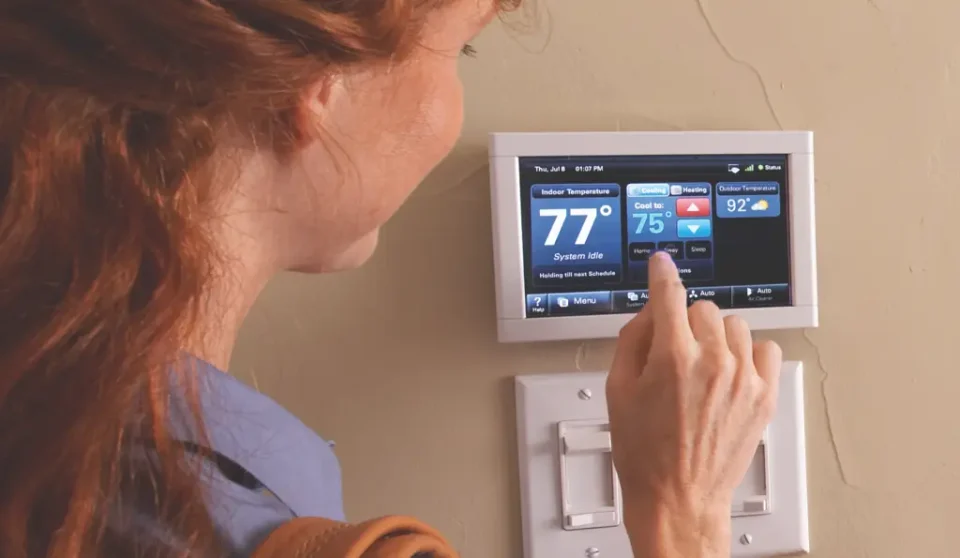
If you utilize a programmable or smart thermostat, clear out your winter heating schedules and establish a summer cooling profile. The recommended baseline temperature for an optimal balance of comfort and energy conservation during the summer is seventy eight degrees Fahrenheit when you are at home. When the house is unoccupied for extended periods or during the work day, adjust the programming to raise the target temperature to eighty five degrees Fahrenheit. This minimizes the total temperature differential between the indoors and outdoors, which slows down the rate of heat transfer into your home and reduces the number of times your air conditioner cycles on.
Ceiling fans should be reconfigured to assist your mechanical cooling. Most ceiling fans feature a small directional toggle switch on the motor housing that dictates blade rotation:
-
Winter Setting: Clockwise rotation at low speed, which draws cool air upward and pushes warm air down from the ceiling.
-
Summer Setting: Counterclockwise rotation at medium or high speed, which pushes air straight down to create a wind chill effect on your skin.
It is important to remember that fans cool people, not rooms. The movement of air across your skin accelerates the evaporation of perspiration, making you feel up to four degrees cooler than the actual ambient room temperature. This allows you to raise the thermostat setting without sacrificing comfort. Turn off all ceiling fans when you leave a room, as running them in an empty space simply wastes electricity.
Ventilation and Household Appliance Adjustments
Daily indoor activities generate substantial amounts of heat and moisture, both of which increase the workload on your residential cooling equipment. Modifying how and when you use major appliances helps maintain a stable, comfortable indoor environment.
Large kitchen appliances, particularly ovens and ranges, introduce massive amounts of radiant heat into your living spaces. During the hottest weeks of summer, shift your cooking strategies away from the main kitchen by utilizing outdoor grills, countertop convection ovens, microwave ovens, or slow cookers, all of which use a fraction of the energy and produce far less ambient heat. When you must use the kitchen stove, run the range exhaust hood to pull hot air and combustion moisture directly out of the building envelope.
Similarly, laundry and dishwashing routines should be optimized for off peak evening hours. Running a clothes dryer or a high temperature dishwasher during the middle of the day releases heat and humidity into your home, forcing the air conditioner to run constantly to remove that moisture. Always operate these appliances with full loads, and select the air dry setting on your dishwasher to eliminate the electrical heating element phase of the cycle.
Frequently Asked Questions
Should I cover my outdoor air conditioner condenser unit during the summer to protect it from the sun?
No. You should never cover the top or sides of an operating air conditioner condenser unit. The system functions by using a powerful fan to pull air through the side coils and blast hot air out through the top of the unit. Placing a cover or a low canopy directly over the operating system restricts this exhaust airflow, causing the compressor to overheat, lose efficiency, and eventually suffer catastrophic mechanical failure.
Does washing clothes in cold water actually save a noticeable amount of energy?
Yes. Roughly ninety percent of the total energy consumed by a standard washing machine is used solely to heat the water inside the drum. By switching your laundry settings to a cold water cycle for summer clothing, you eliminate this heavy electrical resistance load, which significantly reduces your utility costs while preventing excess heat from dissipating into your utility room.
How does attic ventilation affect my summer cooling bills?
Proper attic ventilation is critical because attic temperatures can easily reach one hundred and fifty degrees Fahrenheit on a hot summer day. Active ridge vents, soffit vents, and gable louvers allow this extreme heat to escape naturally via convection. If your attic lacks adequate ventilation, that trapped heat will eventually radiate downward through your ceiling insulation and drywall, raising the temperature of your living spaces and forcing your air conditioner to cycle continuously.
Is it better to leave my central air conditioner fan setting on Auto or On during the summer?
You should always leave the fan switch set to Auto. When the setting is configured to On, the indoor blower fan runs continuously, even when the outdoor compressor is turned off. This continuous airflow blows air over the wet indoor evaporator coil, evaporating the moisture that was just removed from the air and blowing it right back into your home, which increases indoor humidity levels.
Can keeping interior doors closed in unused rooms reduce summer cooling costs?
If you have a standard central air conditioning system, keeping interior doors closed can actually increase your energy bills. Central systems are designed around balanced airflow throughout the entire house. Closing doors blocks the path of supply air and prevents air from returning to the central return grilles. This creates high pressure zones in closed rooms and negative pressure zones in common areas, which forces unconditioned outdoor air to pull in through structural cracks.
Why is my home more uncomfortable in the summer even when the thermostat says it is cool?
This issue is usually caused by high indoor relative humidity. Air conditioners are designed to provide both sensible cooling, which lowers the air temperature, and latent cooling, which removes moisture. If your cooling system is oversized for your home, it will cool the air down very quickly and turn off before it has a chance to run long enough to extract moisture from the air, leaving behind a cold but damp and clammy indoor environment.
