
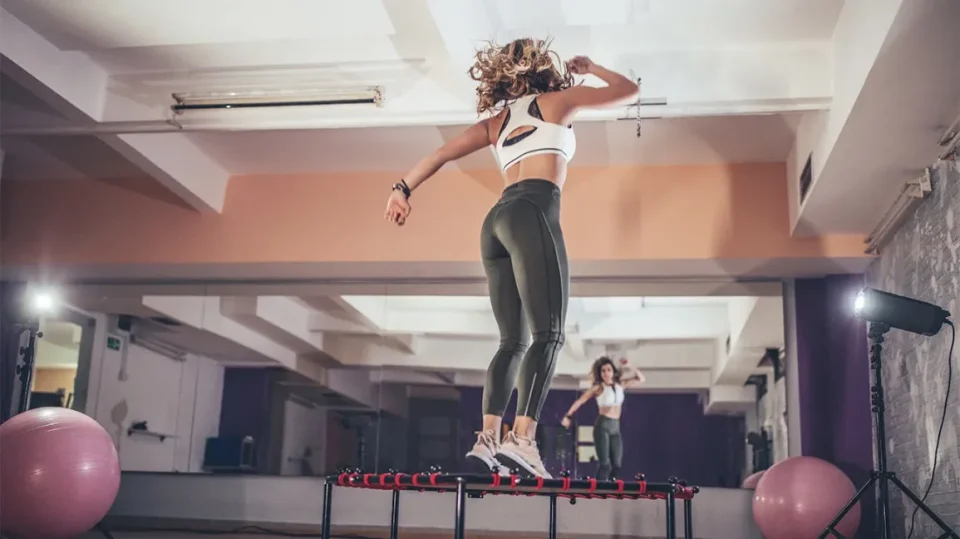
An unstable surface creates a balance challenge, but challenge alone does not guarantee useful practice. If the task is so difficult that every repetition becomes a rescue, the participant may simply repeat compensations. In trampoline fitness Singapore sessions, balance development depends on how well the person can organise vision, trunk position, foot pressure and movement timing as complexity increases.
The most productive task sits between complete comfort and uncontrolled instability. It requires adjustment but still allows the participant to recognise and repeat a successful strategy. This makes balance training a problem of progression, not a contest to create the most unpredictable surface or the largest wobble.
Balance Is an Active Process, Not a Fixed Position
Standing still can look balanced, but the body is continually making small corrections. During rebounding, those corrections become larger and faster because the surface is moving and the participant is changing height, direction and arm position.
The goal is not to eliminate sway. It is to keep movement within a range that can be controlled. A participant who remains centred while making small adjustments demonstrates a different skill from someone who appears rigid until one large correction is required.
Dynamic balance also includes recovery. If the participant lands slightly off-centre, can the next contact restore position without stopping the entire sequence? That ability to detect and correct a manageable error is part of the training effect.
Visual Focus Provides an External Reference
Vision helps the brain estimate body position relative to the environment. Looking around the studio during a difficult sequence can remove a stable reference and make the moving surface feel even less predictable.
A consistent visual target, placed roughly ahead rather than directly at the feet, can support orientation. This does not mean staring rigidly at one point throughout every movement. It means using vision deliberately while learning a pattern.
Once the task is stable, instructors may vary head position or visual demand where appropriate. That progression should be introduced carefully. Removing a reliable visual reference before foot placement and trunk control are established may create more movement without improving the strategy used to control it.
Trunk Control Organises the Movement of the Limbs
The trunk is not required to remain perfectly vertical. It must move in a way that supports the intended direction. When the ribs and pelvis rotate or tilt unpredictably, the arms and legs have to correct both the choreography and the shifting upper-body mass.
Large arm patterns can expose this problem. A participant may control basic rebounds but lose position as soon as the arms reach overhead or across the body. The issue is not necessarily weak legs. The trunk may not be transferring the arm movement while keeping the centre of mass manageable.
Scaling the arm range can preserve the balance task. The participant first performs a smaller reach without drifting. The arm movement grows only when the trunk can accommodate it. This creates progression through control rather than through instability for its own sake.
Foot Placement Must Be Predictable Before It Becomes Complex
The feet provide the base through which pressure reaches the trampoline. If stance width changes unintentionally on every contact, the body receives a different problem each time. Learning is difficult because there is no stable pattern to refine.
Begin with a stance that can be repeated. The participant should recognise where pressure is felt and whether the feet return to the intended area. From there, stance width, alternating steps or lateral positions can change deliberately.
Toe gripping is not the same as foot control. Excessive gripping can create tension and calf fatigue without improving position. A more useful strategy distributes pressure and lets the ankle, knee and hip coordinate around the moving mat.
Proprioception Needs a Solvable Task
Proprioception refers broadly to information about body position and movement. An unstable surface increases the amount of sensory information that must be interpreted, but the nervous system still needs a task it can solve.
If the participant is repeatedly stepping off, grabbing support or abandoning the pattern, the chosen variation may be beyond the useful learning range. Reducing bounce height or removing an arm sequence does not eliminate proprioceptive demand. It makes the feedback clearer.
The participant can then connect a specific action with a specific outcome. A centred trunk leads to a more predictable landing. A consistent stance reduces lateral drift. That cause-and-effect relationship is more valuable than random difficulty.
Research Findings Do Not Remove the Need for Progression
Clinical and exercise studies have reported balance improvements following structured mini-trampoline programmes. For example, a controlled mini-trampoline programme improved postural control in a specific rehabilitation population.
That result should not be generalised into a promise that any trampoline activity improves balance for every person. The programme was predefined, supervised and delivered to a particular group. The useful lesson is that structured practice matters. The unstable surface was part of an organised intervention, not the entire explanation.
Fitness classes should follow the same reasoning. Progression, coaching and repeated exposure determine whether participants learn a better strategy or simply survive an unpredictable task.
Complexity Should Increase Along One Dimension at a Time
Balance demand can be changed through bounce height, cadence, stance, direction, arm movement, visual focus and choreography. Increasing several together makes it difficult to identify what caused control to fail.
A clear progression may start with compact vertical rebounds at a steady cadence. The next step adds a deliberate arm pattern. Later, the participant introduces lateral travel while keeping the original arm position. Faster cadence comes after the landing path remains consistent.
This does not make the class mechanically repetitive. It creates a hierarchy inside the choreography. Participants can choose which layer to perform based on current control.
Fatigue Can Turn a Balance Task Into Noise
Balance often deteriorates before a participant feels completely exhausted. Calf fatigue changes ankle control, breathing alters trunk tension, and attention narrows as the session becomes harder.
The participant should observe whether errors remain small and correctable. If each lateral movement requires a large arm swing or extra rebound, the nervous system may no longer be practising the intended pattern. A simpler option can restore useful feedback.
Recovery intervals also matter. Gentle bouncing still requires balance, so the participant may need a lower movement range or a brief pause to regain control. The aim is not perfect stillness, but enough recovery for the next work interval to begin with a repeatable strategy.
Measure Balance Through Repeatability
Wobble is easy to notice but difficult to interpret. Better metrics describe what the participant can repeat. Did the feet land in the intended area? Could the person complete the sequence without an extra recovery contact? Did control remain when the arms changed position? Could the same quality be maintained late in class?
Movement confidence is another useful measure when it reflects actual behaviour. A participant may report greater confidence and also use less visual checking, fewer rescue steps or a slightly larger controlled range. Confidence without observable control may simply reflect familiarity.
Record one marker for several sessions. Changing the metric every week makes progress difficult to see. A simple repeated task provides more information than a collection of unrelated challenges.
Instability Must Be Appropriate to the Individual
Training history, age, previous injury, vestibular function and current symptoms can affect balance. A variation that is productive for one participant may be unsuitable for another.
Dizziness, faintness, sudden neurological symptoms or persistent instability should not be treated as ordinary training difficulty. Group instructors can scale exercise, but they cannot diagnose individual medical causes. Appropriate professional assessment is necessary when symptoms are concerning.
For participants who are otherwise well, the best starting point is the most challenging variation that still allows controlled success. Difficulty can grow from that baseline.
Coaching Makes the Surface Educational
In xBounce classes available through TFX Singapore, instructor cues can help participants choose visual focus, stance and movement range before adding speed or choreography. The surface supplies feedback, while coaching helps organise what that feedback means.
Balance gains do not come from wobbling as much as possible. They come from detecting movement, making an effective correction and repeating that solution under gradually greater demand. Control is not the opposite of challenge. It is what turns challenge into practice.
Frequently Asked Questions
Should I look at my feet during trampoline balance work?
Occasional checking may help with setup, but a stable forward visual reference often supports orientation better during repeated movement. Follow the instructor’s cue for the specific task.
Is more instability always better for balance?
No. The task must remain solvable. Excessive instability can produce repeated rescue strategies instead of controlled practice.
Why does my balance worsen near the end of class?
Lower-leg fatigue, breathing demand and reduced concentration can change postural control. Reduce range or complexity to restore repeatable landings.
How can I track balance improvement?
Use one observable marker, such as centred landings, fewer recovery contacts or stable arm transitions, and compare it across similar sessions.
